
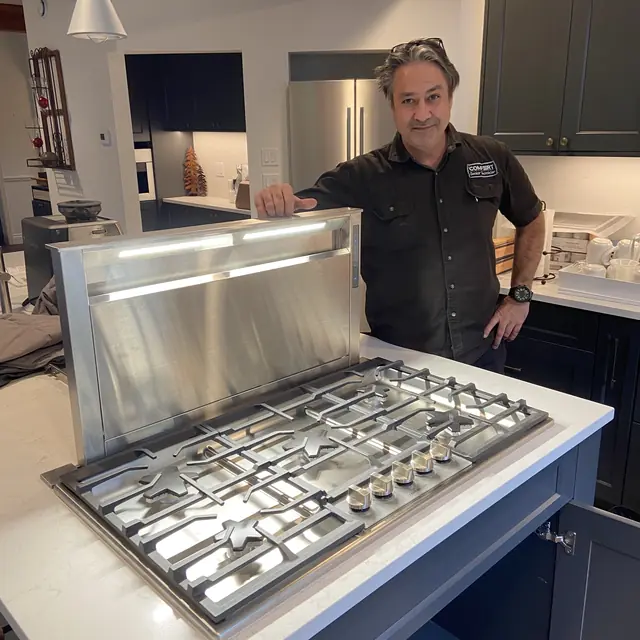
Quick Answer: Induction cooktop repair is usually a job for a technician, not a DIY fix — most faults sit in the power electronics (the inverter, control board or cooling fan) behind the glass. Before you call, run two free checks: test your pan with a fridge magnet, and confirm the cooktop’s dedicated breaker hasn’t tripped. If one zone is dead, the cooktop shuts off mid-cook, or the glass is cracked, stop using it and book a diagnosis — from $95, varies by appliance, with your exact fee confirmed by phone when you call with your make and model.
Induction cooktops are showing up in more Burnaby kitchens every year, and for good reason: they boil water faster than gas, the glass stays cool enough to wipe down minutes after cooking, and there’s no combustion in the kitchen. But when one stops working, the fault is rarely what you’d expect from a gas or coil-electric cooktop. There is no heating element to burn out and no flame to relight. Under the glass sits a stack of power electronics — copper coils, inverter boards, sensors and a cooling fan — and that’s where nearly every induction cooktop repair begins.
This guide covers what actually breaks on induction cooktops, the safe checks you can run yourself, what repair typically costs, and when replacing the cooktop is the smarter call.
How induction works — and why it fails differently
An induction cooktop doesn’t heat the glass. It drives alternating current through a copper coil beneath the glass, creating a magnetic field that induces heat directly inside a ferromagnetic pan. The pan becomes the heating element. That design is what makes induction fast and efficient — and it means the failure points are electronic, not thermal.
The four layers that matter for repair:
- The pan — must be magnetic (cast iron, carbon steel, magnetic stainless). A non-magnetic pan simply won’t heat, and the cooktop isn’t broken.
- The glass-ceramic top — a passive barrier. It can crack from a dropped pot or thermal shock, and a crack is a safety issue, not a cosmetic one.
- The copper coil — rarely fails on its own; usually damaged by liquid getting past the glass seal.
- The inverter and control board — the IGBT power transistors switch thousands of times per second and run hot, which is why every induction cooktop has an internal cooling fan. Most induction cooktop repair work happens here.
Because the electronics carry high voltage even when the cooktop is switched off, anything behind the glass is technician-only work. The safe homeowner checks below never require opening the unit.
The two checks to run before you call
1. The magnet test
Put a fridge magnet on the base of the pan. If it sticks firmly, the pan works on induction. If it slides off or barely holds, the pan won’t heat — no matter how new the cooktop is. Cast iron and magnetic stainless work; aluminium, copper, glass and most non-magnetic stainless don’t. A surprising share of “my induction cooktop won’t heat” calls turn out to be cookware carried over from a gas or coil-electric kitchen. Ten seconds with a magnet can save you a service call.
2. The breaker and power check
Induction cooktops draw heavy current on a dedicated 240V circuit — typically 30 to 50 amps depending on the unit. Check your electrical panel for a tripped breaker, and confirm the cooktop’s display has power at all. A cooktop that is completely dead with no display may have a supply problem rather than an appliance fault. If the breaker trips again as soon as you reset it, leave it off and call a technician — don’t keep resetting it.
What actually breaks: symptom, cause, action
| Symptom | Likely cause | What to do |
|---|---|---|
| One zone dead, others work | Failed inverter / IGBT module for that zone | Technician diagnosis; inverter board replacement is the most common induction repair |
| Cooktop shuts off mid-cook, restarts when cool | Cooling fan seized; electronics overheat and the safety circuit cuts power | Fan motor replacement; don’t keep cooking through shutdowns |
| F-code or E-code on the display | Brand-specific fault (sensor, board, communication error) | Note the exact code and model number; codes differ by brand and must be decoded against the service manual |
| Touch controls unresponsive | Moisture or grease under the touch zone, or a failed touch PCB | Clean and dry the surface; if it persists, the touch board needs testing |
| Cracked or chipped glass | Impact or thermal shock | Stop using the cooktop, unplug it, and have the glass plate replaced — cracks let liquid reach the electronics |
| No zone heats, display works | Pan detection fault, power board, or wrong cookware | Magnet-test your pans first; if pans are fine, the power board needs diagnosis |
| Breaker trips under load | Undersized or aging circuit, or an internal short | Verify the circuit rating against the nameplate; persistent tripping needs a technician (and possibly an electrician) |
F-codes: decode first, replace second
Induction error codes look simple — F0, F2, F7, E6 — but the same code means different things on different brands. F7 on a Miele is not F7 on a Thermador. A technician decodes the exact code against your model’s service documentation before touching a part, because guessing from a generic chart is how good control boards get replaced while a $40 sensor was the real fault. When you call, have the code and the model number ready: it often lets the technician arrive with the right part.
Cracked glass: stop using it
A cracked induction plate cannot be glued or patched. Glass cooktop repair on an induction unit means replacing the whole plate: the crack lets liquid reach the electronics below, and heat can spread the crack further. Stop using the cooktop, switch it off at the breaker, and have the glass plate replaced. Glass is one of the most expensive single parts — published 2026 US guide ranges (Angi) put glass-top replacement at roughly $250–$600, with ceramic glass on premium brands running higher — so on an older cooktop, a cracked plate is often the repair that tips the decision toward replacement. Our guide to whether to repair or replace an appliance walks through that call in detail.
What does induction cooktop repair cost?
Published 2026 US guide ranges (Angi) put induction repairs at roughly $200–$500+ overall, with control-board work at $200–$600 and glass-top replacement at $250–$600. Canadian pricing varies by brand, part availability and model — premium European brands sit at the top of every range.
At Comfort Appliance Service, diagnosis starts from $95, varies by appliance — call with your make and model to confirm your exact fee before the visit. The technician diagnoses the fault, quotes the repair in writing, and you decide with the real number in front of you. Every repair carries a warranty of 1 week–90 days, set by the technician based on the part and the job.
As a rule of thumb, if the quoted repair is more than about half the price of a comparable new cooktop and the unit is past its first decade, replacement is usually the better use of the money. That 50% test is a guide, not a law — a single-zone inverter repair on an otherwise sound four-year-old cooktop is almost always worth doing.
Induction cooktop installation: getting it right the first time
Many induction faults trace back to the install, not the appliance: an undersized circuit, a cabinet with no airflow for the cooling fan, or a cooktop fitted without the clearances the manual requires. If you’re switching from gas or coil-electric to induction, the job includes a dedicated 240V circuit, a check of the cabinet ventilation, and a countertop cutout that matches the new unit — induction cooktop installation is worth doing once and doing properly. The same applies to gas cooktop installation if you’re going the other direction, and to electric cooktop installation generally: the circuit and the clearances are the parts that cause callbacks.
When to call a technician
Call a pro if any of these apply: a zone is dead, the cooktop shuts off under load, an F-code won’t clear, the glass is cracked, or the breaker keeps tripping. Don’t open the cooktop yourself — the power electronics hold high voltage even when the unit is switched off. Our cooktop repair and installation service covers induction, gas and glass-top cooktops across Burnaby, Coquitlam and Vancouver, and our oven repair and installation team handles the range and wall-oven side of the kitchen. For the wider picture on what goes wrong with home appliances, see our guide to common home appliance problems, and for everyday care, our professional appliance service and repair tips.
Induction is a different machine from the cooktop it replaced — faster, cooler, and more electronic. When it needs appliance repair, the fix is usually a single board, a fan or a sensor, diagnosed properly the first time.
Frequently Asked Questions
Why won’t my induction cooktop detect my pan?
Most often the pan isn’t magnetic. Test it with a fridge magnet — if it doesn’t stick firmly, the pan can’t work on induction. If the pan is magnetic and still isn’t detected, the pan-detection sensor or the inverter for that zone may have failed, and the cooktop needs a technician’s diagnosis.
What does an F7 code mean on an induction cooktop?
It depends on the brand. On many European models an F-code in the F7 range points to a main control board or power-supply fault, but the exact meaning varies by model and firmware. Note the code and your model number and have them ready when you call — decoding against the service manual is part of the diagnosis.
Can a cracked induction cooktop be repaired?
The glass plate can be replaced, but it cannot be patched or glued. Stop using the cooktop and switch it off at the breaker, because cracks let liquid reach the electronics. Glass is the most expensive common part, so get a written quote before deciding between repair and replacement.
How long does an induction cooktop repair take?
Most single-part repairs — a fan, a sensor, an inverter module — are completed in one visit when the part is in stock. Premium-brand boards sometimes need ordering, which can add days. The diagnostic visit itself confirms the fault and the timeline before any work starts.
Is it worth repairing an induction cooktop?
Usually, yes, when the fault is a single board, fan or sensor and the cooktop is under about ten years old. Apply the 50% test: if the repair costs more than half the price of a comparable new cooktop, replacement is usually the better choice — especially with a cracked glass plate on a premium brand.
Sources
- Angi — How Much Does It Cost to Repair a Stove? [2026 Data] — https://www.angi.com/articles/how-much-do-kitchen-appliance-repairs-cost.htm — (induction repair bands $200–$500+, glass-top replacement $250–$600, control-board repair $200–$600)
- GE Appliances — Service and Support — https://www.geappliances.com/ge/service-and-support/ — (manufacturer service and parts support)
- ENERGY STAR — Energy Efficient Products — https://www.energystar.gov/products — (certified electric cooking products)