
Quick Answer: Here’s how to fix washing machine not spinning faults: work through the simple causes first — redistribute an unbalanced load, check the lid switch or door lock, then check the drain, because a washer that can’t drain won’t spin. If there’s standing water in the drum, the problem is drainage (filter, hose or pump), not the spin itself. If the drum won’t turn at all and the safe checks don’t fix it, the belt, motor coupling or control is the likely fault, and that’s a technician’s job. Diagnosis starts from $95, varies by appliance — call with your make and model to confirm your exact fee.
Sopping wet clothes at the end of a wash cycle are one of the most common laundry-room complaints — and one of the most fixable. A washing machine not spinning usually has a simple cause, and the checks below go from easiest and most likely to the ones that need a technician. Work through them in order, and stop when you reach a step that needs tools, panels removed, or a part replaced.
Safety first: unplug the washer before removing any panel or reaching underneath it, and turn off the water valves if you’ll be moving the machine or disconnecting hoses. Never bypass the lid switch as a permanent “fix” — the spin cycle is a real safety feature, and the switch is there for a reason.
First: spin, agitate, or both?
What exactly is the washer doing? The answer narrows the fault fast:
- No spin only — the washer agitates or tumbles during the wash, but the tub won’t ramp up to spin speed. Suspects: unbalanced load, lid switch or door lock, slow drain, belt, clutch, or control.
- No agitate and no spin — the washer fills but nothing moves. Suspects: lid switch or door lock, motor coupling (common on direct-drive top-loaders), belt, motor, or control.
- Hums but won’t move — suspects: jammed pump, seized tub, worn coupling, or a belt that slipped off.
- Standing water left in the tub — a lot of “won’t spin” complaints are actually “won’t drain.” If there’s water sitting in the drum, jump to check 4.
The 7 checks, in order
1. Redistribute an unbalanced load
This sounds too simple, but it’s the most common reason a washer won’t spin. Modern machines detect heavy shaking and slow down or stop the spin to protect themselves. Pause the cycle, open the lid or door once it’s safe, and spread the load evenly around the drum — a single heavy item (a duvet, a bath mat, a pair of jeans) on one side is the classic trigger. Also check the washer is level: adjust the levelling feet so the machine doesn’t rock when you push on opposite corners. Then run a spin-only cycle. Error codes like UB, UL or UE (they vary by brand) point to the same cause.
2. Check the power and the settings
Confirm the washer is plugged directly into the outlet — not an extension cord — and that the breaker hasn’t tripped. Check the cycle: some cycles (delicate, wool, no-spin) deliberately skip or slow the spin, and a low spin-speed setting can look like a failure. Run a normal cycle with a spin speed selected and see if the problem persists.
3. Check the lid switch or door lock
Most washers won’t spin with the lid open. On a top-loader, a small switch senses the lid is closed; on a front-loader, a door lock confirms the door is latched. If that sensor fails, the washer may wash but refuse to spin — or do nothing at all. Look at the lid strike (the small plastic tab on the lid that presses the switch): if it’s cracked or missing, the switch never gets pressed. You can test the theory on a top-loader by selecting the spin cycle and manually pressing the switch with a finger — if the machine starts spinning, the strike or switch is the fault. Don’t bypass it permanently; a failed lid switch is a cheap part and a quick repair.
4. Clean the drain pump filter
If there’s standing water in the drum, the washer can’t drain — and a washer that can’t drain won’t enter the high-speed spin. Most front-loaders have a drain pump filter (sometimes called a coin trap) behind a small flap at the bottom front of the machine. Put down a towel and a shallow tray, unscrew the filter cap slowly — water will come out — and clear out lint, coins, hair ties and small clothing items. On a top-loader, check the drain hose for kinks and blockages instead. Then run a drain-and-spin cycle.
5. Check the drain hose
A kinked, blocked or incorrectly installed drain hose stops water leaving the drum. Check the hose for kinks where it runs to the standpipe or sink, and confirm it isn’t pushed too far down the standpipe (which can cause siphoning) or sitting in a way that lets water flow back. If the hose is clear and the filter is clean but the drum still holds water, the drain pump itself may have failed.
6. Look and listen for the belt
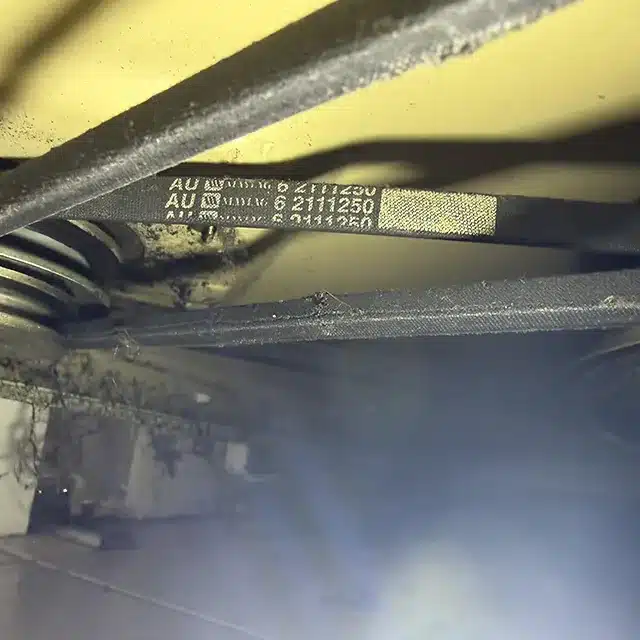
If the washer uses a drive belt, it connects the motor to the drum. A broken or slipped belt means the motor runs but the drum stays still — you’ll hear the motor, but nothing turns. Checking the belt means removing a panel, which is where most homeowners should stop: unplug the machine first, and if you’re not comfortable with panels and pulleys, this is the point to call a technician. A belt is a low-cost part; the value of the visit is confirming it’s the belt and not the motor or control.
7. Note the error code — then call
If the display shows a code, write it down with the model number before you call. Drain codes (Samsung 5C, for example), motor codes (3C/3E series) and lid-lock codes each point the technician at the right part before the visit, which is often the difference between a one-visit fix and two.
Symptom, cause, action
| What you see | Most likely cause | Your next step |
|---|---|---|
| Wet clothes, no standing water | Unbalanced load or lid switch | Redistribute the load; check the lid strike; run spin-only |
| Standing water in the drum | Blocked filter, kinked hose, failed pump | Clean the filter; check the hose; call if it still won’t drain |
| Motor runs, drum still | Drive belt or motor coupling | Technician — panel work and part replacement |
| Hums, nothing moves | Jammed pump or seized component | Technician — don’t keep running it |
| Stops mid-cycle with a code | Brand-specific fault (drain, motor, lock) | Note the code and model number, then call |
| Won’t spin on any cycle, no code | Control board or motor fault | Technician diagnosis |
When to stop DIY and call a pro
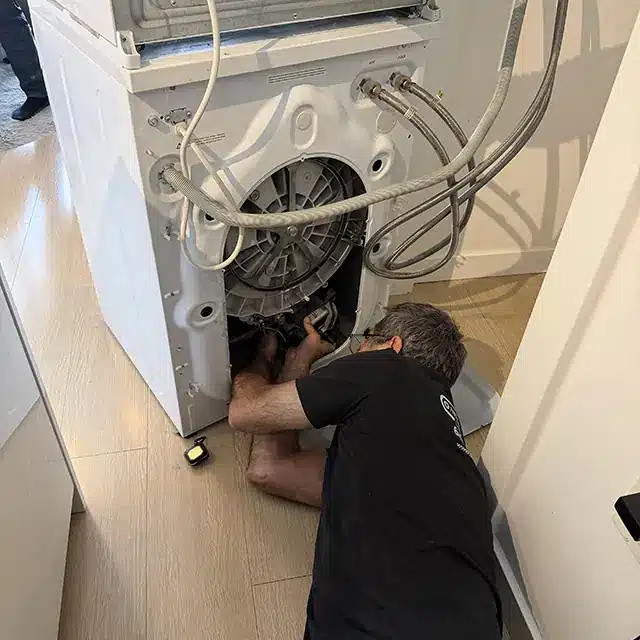
Call a technician if any of these apply: the drum doesn’t turn at all on any cycle, the washer hums or grinds without moving, there’s a burning smell, the machine trips the breaker, water is leaking, or the safe checks above didn’t fix it. Internal work — belts, pumps, couplings, motors, control boards — needs the right part matched to the exact model, and a wrong guess costs you a part you didn’t need plus a second visit.
That’s also the point where cost matters: our washer repair cost guide gives the published ranges for every common washer repair, from a lid switch to drum bearings, so you know what the fix should run before anyone quotes it.
What happens on a repair visit
You call with your make, model, symptom and any error code. The diagnostic visit — from $95, varies by appliance — identifies the failed part, and you get the repair quoted in writing before any work starts. Most no-spin repairs (pump, belt, lid switch, valve) finish in that same visit. Every repair carries a warranty of 1 week–90 days, set by the technician. Comfort Appliance Service covers Burnaby, Coquitlam and Vancouver through our washing machine repair service and washing machine repair in Burnaby.
For the wider picture, our complete guide to washing machine repair covers the repair process from diagnosis to parts, our complete guide to troubleshooting common washing machine problems covers the other faults a washer develops, and how to fix a washing machine covers the general fix-it-first approach. When you need to repair washing machine faults properly, the sequence is always the same: the simple checks first, the right diagnosis second, and the repair only when you know what’s actually broken. That’s the standard for a washing machine fix that lasts — and for appliance repair generally.
Frequently Asked Questions
Why is my washing machine not spinning but the drum still turns by hand?
If the drum turns freely by hand but won’t spin under power, the fault is usually the drive belt, the motor coupling, the lid switch, or the control — not the drum itself. Run the load-balance and drain checks first; if those don’t fix it, the machine needs a technician’s diagnosis.
Why won’t my washer spin with water still in the drum?
A washer won’t enter the high-speed spin until it has drained. Standing water means a drainage problem: a blocked pump filter, a kinked drain hose, or a failed drain pump. Clean the filter and check the hose first.
Can an unbalanced load permanently damage a washer?
A single unbalanced spin usually just stops the cycle, but repeated heavy imbalance wears the suspension, bearings and drive components over time. Redistribute heavy items and keep loads balanced — and check the machine is level.
How much does it cost to fix a washing machine that won’t spin?
It depends on the part: published 2026 guides put a lid switch or belt roughly between $140 and $280, a drain pump roughly between $180 and $320, and a motor coupling roughly between $200 and $340. See our washer repair cost guide linked above for the full table.
Should I keep running a washer that hums but won’t spin?
No. A humming motor with no drum movement suggests a jammed pump, a seized component or a failed coupling, and continuing to run it risks burning out the motor. Unplug the machine and call a technician.
Sources
- Samsung — What to do if your washing machine is not spinning
- Angi — How Much Do Kitchen Appliance Repairs Cost?
- This Old House — How Much Does Appliance Repair Cost?