
Quick Answer: GE washer repair Burnaby: the most common calls involve a washer that won’t drain, won’t spin, leaks, or stops mid-cycle. Start with the safe checks: redistribute the load, check the lid latch, clean an accessible drain filter, and inspect the hoses. If the drum won’t move, the machine trips a breaker, or an error code keeps returning, switch it off and book a technician — belt, motor, and control-board work is not a homeowner repair.
GE has made home laundry appliances for over a century, and its washers — top-load, front-load, and high-efficiency models — are common across Burnaby homes, from Metrotown condos to detached houses in South Slope. They are built for heavy use, but like any machine they develop faults over time. This guide covers the most frequent GE washer problems, what causes them, the safe checks to try first, and when to call for GE washer repair from a local technician.
For the general fault-by-fault version of washer troubleshooting, see troubleshooting common washing machine problems and how to fix a washing machine. This post is GE-specific: the faults, parts, and checks that apply to GE machines in particular.
Common problems with GE washers
Not draining. The most frequent GE complaint: clothes left soaking wet at the end of a cycle. Usually a clogged drain pump filter or a kinked drain hose. Many GE models have an accessible cleanout trap — check your manual for its location.
Not spinning or not agitating. Often an unbalanced load, a faulty lid switch, or a worn drive belt. In top-load GE washers, agitator or transmission faults can also stop the wash action while the motor still runs.
Loud noises. Banging or grinding during spin usually means an unbalanced load, a washer that is not level, or a foreign object such as a coin trapped between the drum and tub. Persistent grinding with balanced loads points to worn bearings or suspension parts.
Water leaks. Usually damaged door seals, loose hoses, or overflowing detergent dispensers. Check hoses and seals first, and use only the detergent dose recommended for your load — excess suds in a high-efficiency machine can overflow and confuse sensors.
Stops mid-cycle. Often a thermal fuse, timer, or control fault, but first rule out an unbalanced load and a drain blockage, both of which can halt a cycle.
Bad odours. In front-load models, mould builds up in the door gasket when moisture sits after washes. Wipe the seal dry, leave the door ajar, and run a hot cleaning cycle monthly.
Error codes. GE washers display codes that point to the area at fault — fill, drain, door, or balance — rather than naming the exact part. Note the exact code and check your model’s manual for its meaning; a code alone does not justify ordering a part without diagnosis.
What causes GE washer faults
Overloading is the most common cause: it strains the motor, suspension, and belt. Using non-HE detergent in a high-efficiency machine creates excess suds that confuse sensors and leave residue. Wear and tear affects belts, pulleys, and pumps over years of daily use, and in older models mechanical timers fail more often than the electronic controls in newer units. Improper installation — a washer that was never levelled — causes vibration that wears out suspension parts early.
One local note: Metro Vancouver’s water supply is soft, so mineral scale is rarely the cause of GE washer faults in Burnaby. The local factors that do matter are humidity in coastal homes, which promotes mould in door seals, and the compact laundry closets in Burnaby condos, where a washer that is not perfectly level vibrates against walls.
GE washer symptom, safe check, and when to call
| Symptom | Safe user check | Call a technician when |
|---|---|---|
| Not agitating | Redistribute load, check lid latch | Motor runs without agitation, or drum will not move |
| Stops mid-cycle | Balance load, check drain hose and filter | Error repeats, or machine will not drain |
| Loud banging | Level feet, redistribute load, check for objects | Banging continues with balanced loads |
| Clothes soaking wet | Drain-and-spin cycle, check filter and hose | Spin still fails, or water pools in the drum |
| Leaking | Check hoses, seals, and detergent dose | Leak continues, or water comes from inside the cabinet |
| Bad odour | Clean seal and drawer, hot cleaning cycle | Odour persists, or mould spreads in the seal |
Safety note: always disconnect power before any permitted check, and never open panels or touch wiring. Internal electrical, motor, and control-board work is for a qualified technician.
When to call a professional
DIY can handle the basics, but most GE washer faults beyond filters, hoses, and load balance need expert attention. Call promptly if you see persistent error codes, electrical smells, leaks that could damage flooring, or a machine that trips a breaker. A technician diagnoses with manufacturer-specific codes and tools, uses compatible parts, and can usually complete common repairs in one visit. Diagnosis starts from $95, varies by appliance — call with your make and model to confirm your exact fee before the visit. Repairs are covered by a warranty of 1 week–90 days, set by the technician.
For the full repair process — diagnosis, parts, costs, and the repair-vs-replace decision — see the washing machine repair guide.
Preventive maintenance for GE washers
Run a monthly cleaning cycle with a washer cleaner or vinegar to combat build-up. Avoid overloading and use the correct detergent amount for your load size. Inspect hoses annually for cracks and replace worn inlet hoses before they burst. Keep the laundry area ventilated to reduce moisture, and level the machine periodically, especially after moving. A professional inspection every one to two years catches belt wear, seal damage, and drainage problems early.
Where to find your GE washer model number
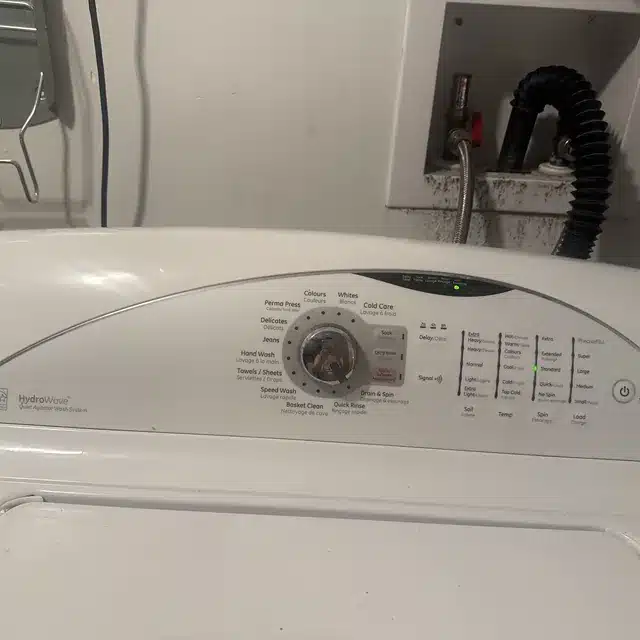
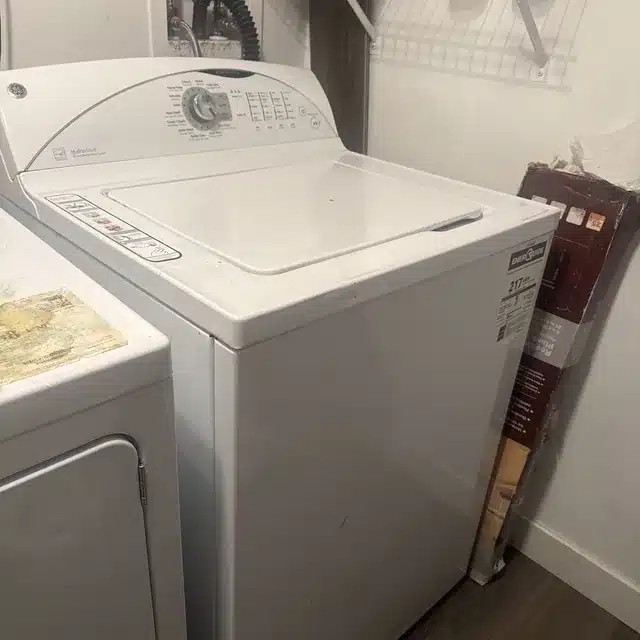
Before you book a repair, note down the washer’s full model number so the technician can confirm the right parts. On most GE top-load washers the model plate is inside the lid; on front-load washers it is usually just inside the door opening or on the back of the machine. Have the model number ready when you book, along with a description of the problem and any error code shown.
Other GE appliances we service
GE makes more than washers. If your GE dryer is not heating or your GE fridge is not cooling, the same diagnostic approach applies: safe checks first, then a technician. See dryer repair and installation for GE dryer repair, and GE fridge repair in Burnaby for GE refrigerator repair. For residents in nearby areas, washing machine repair in Coquitlam covers the same GE washer service.
Comfort Appliance Service provides washing machine repair and installation across Burnaby, Coquitlam, and Vancouver. For GE washer repair Burnaby residents can rely on, call with your model number and symptom ready — and for home appliance repair from a local team that knows GE machines, the same call covers every appliance in your home.
Frequently Asked Questions
Why is my GE washer not agitating during the wash cycle?
A washer that fills but does not agitate may have an unbalanced load, a faulty lid switch, a worn drive belt, or a control problem. Pause the cycle, redistribute the clothes, and check that the lid latches firmly. If the drum still does not move, or the motor runs without agitation, switch off and call a technician — belt and motor work is not a homeowner repair.
Why does my GE washer stop mid-cycle and not spin?
Mid-cycle stops are often caused by an unbalanced load, a drain blockage, or a lid-switch fault that tells the machine the lid is open. Redistribute the load, clean an accessible drain filter, and check the drain hose for kinks. If the washer still stops, displays an error, or will not drain, a technician should test the lid switch, pump, and control board.
How do I reset my GE washer safely?
Switch the washer off, unplug it for about a minute, then plug it back in and run a short rinse-and-spin cycle with no load. This clears some temporary control glitches, but it does not fix mechanical faults, leaks, or repeated error codes. If the same problem returns after a reset, or the machine trips a breaker, stop using it and book a technician.
Is it worth repairing an older GE washer in Burnaby?
Repair is usually worthwhile if the machine is under about 10 years old, the fault is a single part such as a pump or belt, and the quote is well under half a replacement’s cost. Replacement makes more sense if faults keep returning, the tub or transmission is failing, or parts are unavailable. Ask for a clear diagnosis and quote to compare honestly.