
It always happens at the worst possible time. You toss in a load before work, hit start, and come back to a washer that’s dead silent, or worse, one that’s groaning like it’s in real pain.
Before you panic or start pricing out a brand-new machine, take a breath. Most washer problems are more annoying than serious, and many can be fixed in under an hour without a technician anywhere in sight.
This guide covers how to fix washing machine problems using seven simple, real-world fixes that actually hold up. Along the way, you’ll learn what usually causes each issue, roughly what professional help costs in Canada, and when a repair genuinely calls for a professional instead of a YouTube tutorial.
Common Washing Machine Problems (And What They’re Telling You)
Every strange noise, puddle, or stalled cycle is your washer trying to tell you something specific. Most issues trace back to a small handful of parts: the lid switch, the drain pump, the drive belt, or the water inlet valve.
Knowing how to fix a washing machine starts with recognizing the pattern rather than guessing. Below is a quick breakdown of what technicians see most often, along with typical Canadian repair costs, so you know roughly what you’re dealing with before you even open the manual.
| Problem | Likely Cause | Quick DIY Check | Typical Repair Cost (CAD) |
| Won’t start | Door latch, control lock, or power issue | Confirm the door is fully closed, reset the breaker | $80–$300 |
| Won’t spin | Worn lid switch, belt, or motor coupler | Check for an unbalanced load first | $80–$160 |
| Won’t drain | Clogged pump filter or kinked hose | Clear the filter, straighten the hose | $100–$160 |
| Leaking | Loose hose, worn door seal, too much detergent | Tighten connections, cut back on soap | $80–$150 |
| Loud noises | Unbalanced load or worn bearings | Rebalance the load, check for coins in the drum | $80–$400 |
| Musty smell | Detergent buildup or a damp door gasket | Run a hot cleaning cycle, wipe the gasket dry | Usually free (DIY) |
| Overflowing | Faulty inlet valve or pressure switch | Check the fill valve, avoid overloading | $100–$250 |
These ranges line up with what Canadian appliance technicians typically report for parts and labour combined. However, your exact price still depends on the brand, the age of the machine, and how easy the failing part is to reach.
7 Easy Fixes for a Washing Machine at Home
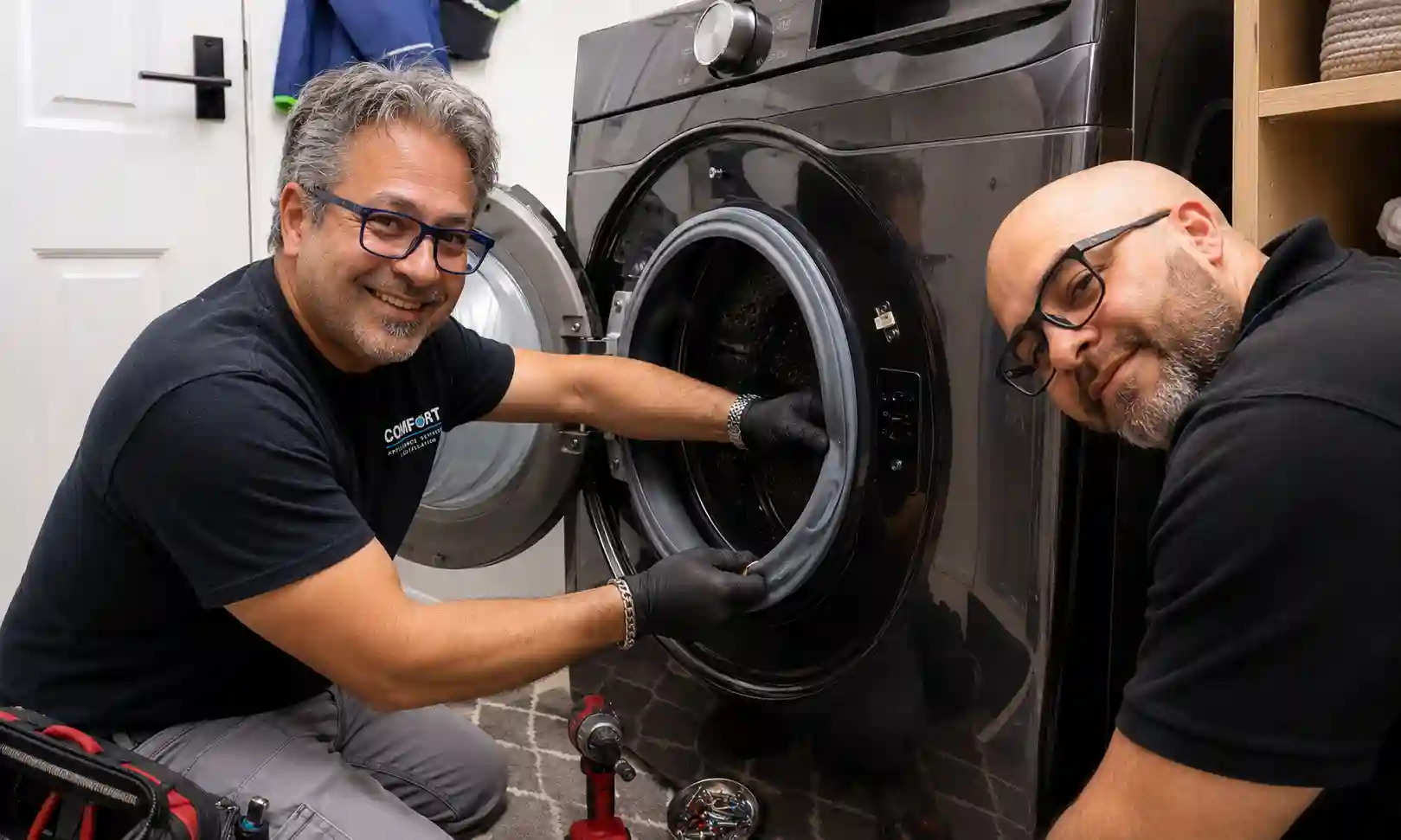
Here’s how to fix washing machine problems yourself, one common issue at a time. None of these require special tools beyond a screwdriver and a bit of patience.
1. It Won’t Start
Check three things first: the power cord, the breaker, and the door latch. Many modern washers won’t start at all if the door isn’t fully clicked shut, which trips people up more often than you’d expect. If the outlet is fine and the door latches properly, the control lock feature may be switched on by mistake. Hold the lock button for three seconds and try again.
2. It Won’t Spin
This is one of the most common calls appliance technicians get, and thankfully one of the easiest to solve. An unbalanced load is the number one culprit, so redistribute the clothes evenly and try again before assuming the worst. If that doesn’t help, the lid switch or drive belt may simply be worn out and due for a cheap replacement.
3. It Won’t Drain
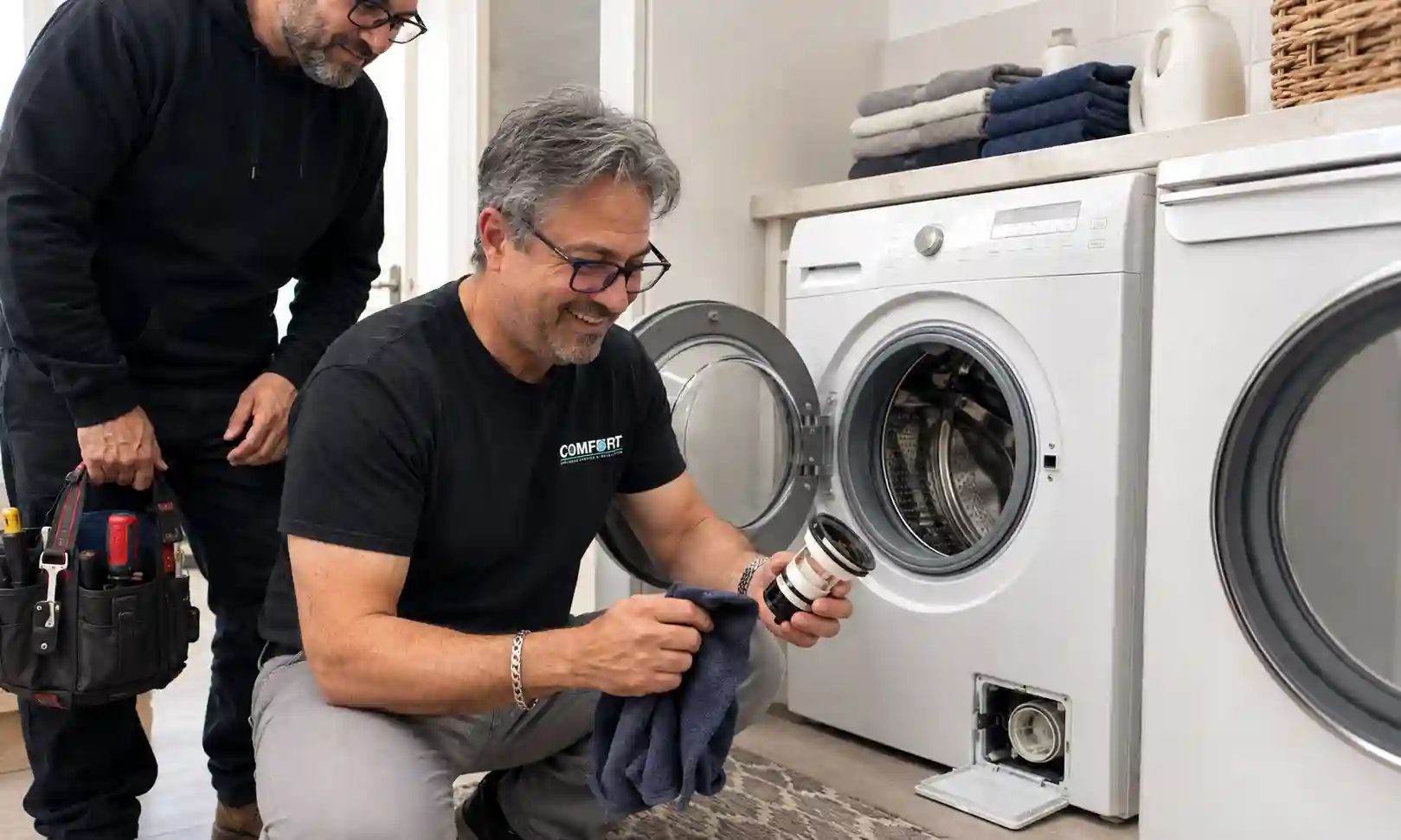
Standing water after a finished cycle almost always means a blocked pump filter. Most front-load machines have a small access panel near the bottom front. Open it, drain any remaining water into a shallow pan, and clear out coins, lint, or the odd stray sock hiding inside.
4. It’s Leaking
Leaks usually come from one of three places: a loose supply hose, a worn door seal on front-load models, or simply too much detergent creating excess suds that escape the tub. Check the hose connections first, since they’re by far the easiest and cheapest fix.
5. It’s Making Loud Noises
A washer that sounds like it’s taking off usually has an unbalanced load or something rattling around loose in the drum. Pause the cycle, redistribute the clothes, and double check pockets for coins or keys. Persistent grinding or squealing, however, often points to worn drum bearings, which is a bigger job.
6. It Smells Musty
Front-load washers are notorious for this one. Moisture gets trapped in the rubber door gasket, and mildew quietly moves in over time. Run an empty hot cycle with a cup of white vinegar once a month, and leave the door cracked open between loads so it can actually dry out.
7. It’s Overflowing or Using Too Much Water
This usually points to a faulty water inlet valve or a stuck pressure switch that isn’t reading the water level correctly. Shut off the water supply right away and avoid running another cycle until the part has been inspected, since this one can cause real water damage if ignored.
How to Fix a Washing Machine That Won’t Spin: A Closer Look
Since this is one of the most searched washer problems in Canada, it earns a bit of extra attention. If your machine fills and agitates normally but the drum never actually spins, work through these steps in order.
- Redistribute the load. A single heavy item, like a comforter or a pair of jeans, is often the entire problem.
- Check the lid or door switch. A worn switch will stop the spin cycle as a safety measure, even when the door is fully closed.
- Inspect the drive belt. On top-load models, a loose or snapped belt is a frequent cause and a genuinely inexpensive part to replace.
- Listen for the motor. A humming sound with no movement usually points to a failed motor coupler, a small part deliberately designed to break before the motor itself gets damaged.
Moreover, if the drum spins freely by hand once the machine is unplugged, that’s a good sign the fix is mechanical rather than electrical, which almost always means a cheaper and faster repair.
DIY Fixes vs. Professional Washing Machine Repair
However, not every problem belongs in the DIY column. Learning how to repair a washing machine yourself can be genuinely satisfying, but electrical issues, control board failures, and anything involving the motor itself are safer left to a licensed technician, both for your safety and the machine’s.
What Does Washing Machine Repair Price Look Like in Canada?
Based on industry pricing data gathered across Canadian repair providers in 2026, most washing machine repair jobs land somewhere between $150 and $450, including both parts and labour. Simple fixes, like a belt or hose replacement, sit at the lower end, while motor or control board work pushes costs noticeably higher.
For example, take a fairly typical case: a Burnaby homeowner’s top-load washer stopped spinning mid-cycle. A quick inspection revealed the culprit was a worn lid switch, a fifteen-dollar part and a twenty-minute fix that avoided a costly replacement entirely. In short, a lot of “my washer is broken” moments turn out to be far more minor than they first appear.
Cost-effective washing machine repair services are often far cheaper than people expect, especially when the problem gets caught early rather than left to get worse. As a general rule of thumb, if a repair costs more than half the price of a new machine, replacement starts to make more financial sense. According to Statista’s household appliance data, most washing machines are built to last somewhere between 10 and 13 years, so a mid-life repair is usually the smarter financial call.
When to Call a Professional in Vancouver, Burnaby, or Coquitlam
For anything involving electrical wiring, gas dryer connections, or a control board that refuses to reset, it’s time to bring in a professional rather than risk making the problem worse.
This is where Comfort Appliance Service and Installation comes in. Widely regarded as the best appliance repair company in Vancouver, Burnaby, and Coquitlam, their licensed technicians handle everything from the everyday washing machine repair Vancouver families rely on, to washer repair Burnaby and washing machine repair Coquitlam service calls throughout the week.
Need help with more than just the washer? Their team also covers dryer repair, general home appliance repair for nearly anything humming, buzzing, or leaking in your home, and even pressure washer repair in Coquitlam for outdoor equipment. Own a commercial-grade unit? Speed queen washer repair calls are handled just as confidently as standard household brands, since these heavy-duty machines often need parts that not every shop bothers to keep on hand.
How to Prevent Washing Machine Problems Before They Start
A little prevention goes a long way toward avoiding this whole list in the first place. Keep these habits in mind:
- Don’t overload the drum. A packed machine strains the motor, belt, and bearings all at once.
- Wipe the door gasket dry after every load, especially on front-load models prone to mildew.
- Use the correct detergent amount. More suds don’t mean cleaner clothes, just more strain on the pump.
- Run an empty hot cycle monthly with vinegar or a washer cleaner to clear out residue.
- Leave the door cracked open between loads so moisture can actually escape.
These small habits are far cheaper than any repair, cost-effective or otherwise, and they noticeably extend the life of the machine.
Conclusion
Most washer problems are more annoying than serious, and that’s genuinely good news. This guide to how to fix washing machine issues, or at least knowing how to repair a washing machine well enough to correctly diagnose the problem, can save real time and real money.
Start with the basics every single time: check the load balance, the door latch, and the hose connections before assuming the worst. When a fix does call for a professional, choosing a trusted local team means the job gets done right on the first visit, not the third.
In short, don’t let one bad laundry day convince you it’s time to replace a perfectly repairable machine. Nine times out of ten, the fix is smaller than the panic.