
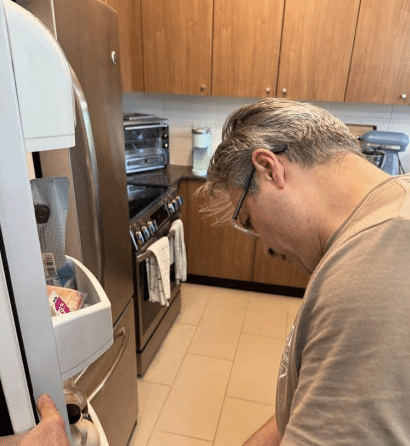
It is one of the most confusing fridge problems: your freezer is still freezing, the ice cream is solid, the frozen food looks fine, but the fresh food section feels warm. The milk is not as cold as it should be. Vegetables are getting soft. Drinks are barely chilled. You open the freezer and everything seems normal, so the first question is simple: how can the freezer work but the fridge not cool?
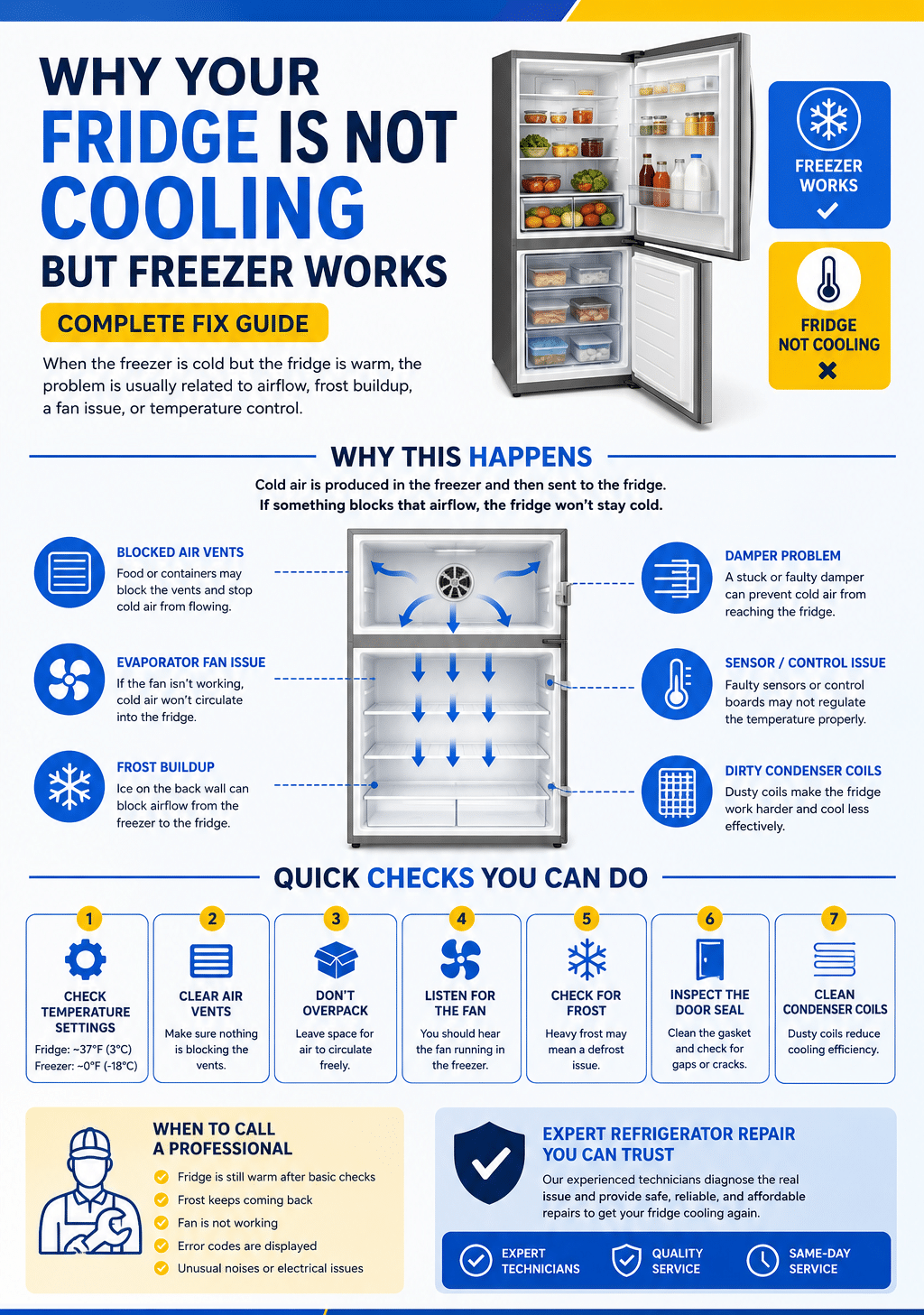
The answer is that most refrigerators do not cool the fridge and freezer as two completely separate systems. In many models, the freezer is where the cold air is produced first. Then a fan and air passages move some of that cold air into the refrigerator section. So when the freezer works but the fridge is warm, the problem is often related to airflow, frost buildup, a failed fan, a blocked vent, a bad temperature control, a dirty condenser, or a defrost issue.
This guide walks you through the most common causes, what you can safely check yourself, when to stop troubleshooting, and when it is better to call a technician. If you are in Burnaby or nearby and need professional help, Comfort Appliance Service provides appliance repair in Burnaby for refrigerators, freezers, washers, dryers and other home appliances.
First, Is This a Serious Problem?
Yes, it can become serious quickly. A fridge that is not cooling properly can spoil food, create unpleasant smells and increase the risk of bacteria growth. Even if the freezer still works, the fresh food section needs to stay cold enough to protect dairy, meat, leftovers, sauces and produce.
As a general rule, your refrigerator section should stay around 37°F or 3°C. The freezer should stay around 0°F or minus 18°C. If the fridge section is above 40°F or 4°C for too long, food safety becomes a concern.
|
Area |
Ideal Temperature |
Warning Sign |
|
Fresh food fridge section |
About 37°F or 3°C |
Above 40°F or 4°C |
|
Freezer section |
About 0°F or minus 18°C |
Food softening or ice melting |
If your fridge is warm but the freezer is still cold, do not ignore it. It usually means the cooling system is partly working, but the cold air is not reaching the fridge section properly.
How a Fridge Can Be Warm While the Freezer Still Works
In many refrigerator designs, the evaporator coils are located behind the freezer panel. These coils get cold. An evaporator fan then pushes cold air through vents from the freezer into the fridge compartment. A damper or air control may open and close to manage how much cold air enters the fridge.
So the cooling chain looks something like this:
- The compressor circulates refrigerant.
- The evaporator coils become cold.
- The evaporator fan moves cold air.
- Air travels through vents into the fridge section.
- The thermostat, control board, damper and sensors help regulate temperature.
If one part of this chain fails, the freezer may stay cold but the fridge can become warm. That is why this problem is often not about the freezer itself. It is more about airflow and temperature control.
Quick Troubleshooting Table
Before going deep into the causes, use this table as a quick starting point.
|
Symptom |
Possible Cause |
What It Usually Means |
|
Freezer cold, fridge warm |
Blocked air vent |
Cold air cannot move into the fridge |
|
Frost on back freezer wall |
Defrost system problem |
Ice is blocking airflow |
|
No fan sound in freezer |
Evaporator fan issue |
Cold air is not being circulated |
|
Fridge warm after grocery loading |
Overpacked shelves |
Air movement is restricted |
|
Fridge runs constantly |
Dirty condenser coils or weak cooling |
System is struggling to remove heat |
|
Temperature changes randomly |
Thermostat, sensor, damper or control issue |
Fridge is not regulating properly |
1. Blocked Air Vents Between the Freezer and Fridge
This is one of the most common and easiest problems to miss. Cold air usually travels from the freezer into the fridge through small vents. If those vents are blocked by food, containers, ice buildup or packaging, the fridge section will not get enough cold air.
This often happens after a big grocery run. People pack the freezer tightly, push items against the back wall or place large boxes in front of the vents. The freezer may still feel cold because the cold air is being produced there, but the refrigerator section becomes warm because the airflow path is blocked.
What to check
- Look for vents inside the freezer and fridge compartments.
- Move food away from the back wall.
- Do not block air openings with bags, boxes or containers.
- Leave some space between items so air can circulate.
- Check if frost or ice is covering the vents.
Simple fix
Rearrange the food and clear the vents. Then give the fridge several hours to recover. Refrigerators do not cool instantly, especially after the doors have been opened many times. If airflow was the only issue, you should notice improvement within a few hours.
2. The Freezer Is Overpacked
An overpacked freezer can create the same problem as blocked vents. It limits airflow and stops the cold air from moving properly. A freezer should be full enough to hold temperature well, but not packed so tightly that air cannot move around.
Think of your fridge like a room with a fan. If furniture is blocking the airflow, one side of the room may feel cooler while another side feels warm. The same thing happens inside the appliance.
|
Freezer Condition |
Effect on Cooling |
Recommended Action |
|
Nearly empty |
Temperature may fluctuate more |
Keep some frozen items inside |
|
Moderately full |
Usually best for stable cooling |
Leave space for airflow |
|
Overpacked |
Air vents may become blocked |
Remove or reorganize items |
3. Frost Buildup Is Blocking Airflow
If you see frost or ice buildup on the back wall of the freezer, that is an important clue. A light layer of frost on food packaging can be normal, but frost building up on the freezer’s interior wall often points to a defrost system problem.
Modern refrigerators usually have an automatic defrost system. This system melts frost from the evaporator coils so air can keep moving. If the defrost heater, defrost thermostat, thermistor, timer or control board fails, frost can build up behind the freezer panel. Eventually, that frost blocks the cold air from reaching the fridge section.
Common signs of a defrost issue
- The freezer still freezes food, but the fridge is warm.
- There is frost on the back wall of the freezer.
- The fridge seems to improve after unplugging and defrosting, then the problem comes back.
- You hear the fridge running often, but the fresh food section stays warm.
- Airflow from the fridge vents feels weak or completely absent.
Can you fix this yourself?
You can temporarily defrost the fridge by unplugging it and letting the ice melt, but that is usually not a permanent repair. If the defrost system has failed, the frost will come back. A technician can test the heater, thermostat, thermistor and control board to find the exact failed part.
4. The Evaporator Fan Is Not Working
The evaporator fan is one of the most important parts in this situation. It is usually located in or behind the freezer compartment. Its job is to move cold air across the evaporator coils and into the refrigerator section.
If the fan stops working, the freezer may still stay cold because the coils are still cold. But the fridge will not receive enough moving air. This is why a failed evaporator fan often causes the exact problem we are talking about: freezer works, fridge does not cool.
How to check the fan
Open the freezer door and listen carefully. In many fridges, the fan stops when the door is open and starts again when the door switch is pressed. You may be able to press the freezer door switch by hand and listen for the fan. If you hear nothing, the fan may be blocked, frozen or failed.
Do not put your fingers or tools near moving fan blades. If you are not comfortable checking it safely, stop there and call a technician.
Possible fan problems
- The fan motor has failed.
- The fan blade is blocked by ice.
- The door switch is not working.
- The control board is not sending power to the fan.
- Wiring or connector issues are preventing operation.
5. The Damper Control Is Stuck Closed
The damper is a small air door that controls how much cold air enters the fridge section from the freezer. If it gets stuck closed, cold air cannot enter the fresh food compartment. If it gets stuck open, the fridge may become too cold and freeze food.
When the freezer works but the fridge is warm, a stuck closed damper is possible. This is especially true if the freezer is cold, there is no major frost buildup, the fan works, but very little cold air enters the fridge section.
Explore our GE appliance services section to see how we handle everything from oven malfunctions to dishwasher performance issues with care and precision.
Signs of a damper problem
- The fridge section is warm while the freezer temperature is normal.
- There is little or no airflow from the fridge vent.
- The damper door does not open or close properly.
- You hear clicking or repeated movement near the damper area.
Some dampers are mechanical. Others are electronic and controlled by sensors or a control board. A technician can inspect the damper and confirm whether it is stuck, broken or not receiving the right signal.
6. Dirty Condenser Coils
Condenser coils help release heat from the refrigerator. Depending on the model, they may be located underneath the fridge or at the back. When these coils get covered in dust, pet hair and debris, the fridge has a harder time removing heat.
Dirty condenser coils may not always cause the freezer to work while the fridge is warm, but they can make cooling problems worse. The fridge may run longer, cool less efficiently and struggle during warm weather or heavy use.
What you can do
- Unplug the fridge before cleaning.
- Locate the coils behind or under the unit.
- Use a coil brush or vacuum carefully.
- Clean dust, lint and pet hair.
- Make sure the fridge has enough space around it for ventilation.
For homes with pets, cleaning condenser coils every six months can help prevent performance issues. For homes without pets, once or twice a year is usually a good habit.
7. Temperature Settings Are Incorrect
This sounds too simple, but it happens more often than people think. Someone adjusts the temperature by accident, kids play with the control panel, food bumps the dial, or the fridge gets switched into a special mode.
Check the settings before assuming there is a major repair needed. Set the fridge around 37°F or 3°C and the freezer around 0°F or minus 18°C. If your fridge uses number settings instead of degrees, check the manual or adjust gradually.
|
Control Type |
What to Do |
Important Note |
|
Digital temperature display |
Set fridge to about 37°F or 3°C |
Wait 24 hours before judging results |
|
Number dial |
Use the middle setting first |
Higher number may mean colder on many models |
|
Smart fridge controls |
Check app and panel settings |
Disable vacation or demo mode if active |
8. The Fridge Door Is Not Sealing Properly
A weak door seal can let warm air enter the fridge. The freezer might still seem okay because it has stronger cooling or is opened less often, but the fridge section can struggle.
Door gasket issues can be sneaky. You may not notice the seal is weak until food starts spoiling faster. A damaged gasket, dirty seal, uneven door or overloaded door shelf can all prevent the door from closing properly.
How to check the gasket
- Look for cracks, tears or loose sections.
- Clean sticky residue from the gasket.
- Close the door on a piece of paper and gently pull it out.
- If the paper slides out too easily, the seal may be weak.
- Make sure food containers are not preventing the door from closing.
If the gasket is damaged, replacement is usually the best solution. If it is just dirty, cleaning it with mild soap and warm water may help.
9. The Fridge Is Too Close to the Wall
Refrigerators need airflow around them. If the fridge is pushed too tightly against the wall or built into a tight cabinet without proper ventilation, heat cannot escape properly. This can make the cooling system work harder than it should.
Built-in style kitchens can look beautiful, but they sometimes create ventilation problems if the appliance was not installed with enough clearance. This is especially true for older fridges or high-capacity models.
What to check
- Make sure the fridge is not pressed tightly against the wall.
- Check the owner’s manual for clearance requirements.
- Do not block the lower front grille.
- Clean dust from the grille and surrounding area.
- Make sure air can move behind and under the unit.
10. The Thermistor or Temperature Sensor Is Faulty
Many modern fridges use thermistors or temperature sensors to monitor internal temperature. These sensors tell the control board when to run the cooling system, open the damper or adjust fan operation.
If a sensor gives incorrect readings, the fridge may think it is already cold enough even when it is not. The result can be warm fridge temperatures while the freezer still works.
Signs of a possible sensor problem
- Temperature readings seem wrong.
- The fridge cools randomly, then warms again.
- The control panel shows error codes.
- The fridge does not respond properly to setting changes.
- The freezer is fine, but the fresh food section is inconsistent.
This is usually not a DIY guess-and-replace repair. Sensors can be tested with proper tools, and different brands use different resistance values. A technician can test the sensor before replacing parts.
11. The Control Board May Be Failing
The control board is like the brain of many modern refrigerators. It receives information from sensors and controls fans, defrost cycles, dampers and compressor operation. If the board fails, the fridge may behave strangely.
A bad control board can cause many symptoms, so it should not be the first part you blame. It is better to check airflow, frost, fans, vents, gaskets and basic settings first. Control boards can be expensive, and replacing one without testing other parts can waste money.
Possible control board symptoms
- Fans do not run when they should.
- The defrost system does not activate.
- Temperature settings do not respond.
- Error codes appear on the display.
- The fridge works sometimes and fails other times.
12. The Fridge Was Recently Loaded With Warm Food
If you just loaded the fridge with a large amount of groceries, leftovers or warm containers, the fridge may need time to recover. Warm food adds heat to the compartment, and the fridge has to work to remove that heat.
This is especially noticeable after holidays, parties or large grocery runs. The freezer may still seem normal, while the fridge feels warmer for several hours.
What to do
- Do not put large amounts of hot food directly into the fridge.
- Let food cool safely before storing it.
- Avoid opening the door repeatedly.
- Leave space between containers.
- Check the temperature again after several hours.
If the fridge does not recover after 12 to 24 hours, there may be another issue.
13. The Fridge Light Stays On
A fridge light that stays on after the door closes can warm the inside of the fresh food section. This is not the most common cause, but it does happen. The freezer may continue working fine while the fridge gets warmer than expected.
The issue may be a faulty door switch, misaligned door or control problem. If you suspect this, touch the area around the light cover carefully after the door has been closed for a while. If it feels unusually warm, the light may be staying on.
14. The Return Air Vent Is Blocked
Refrigerators need air movement in both directions. Cold air enters the fridge section, then warmer air returns to the freezer area to be cooled again. If the return air vent is blocked, airflow becomes unbalanced.
This can cause poor cooling in the fridge section, uneven temperatures and sometimes frost buildup. Return vents are often small and easy to block with food.
For homeowners with LG refrigerators that are not cooling evenly or making unusual noises, Comfort Appliance Service provides expert troubleshooting and parts replacement.
What to check
- Find the vents inside the fridge section.
- Move tall containers away from the back wall.
- Do not line shelves with plastic sheets or mats that block air.
- Keep produce drawers properly positioned.
15. The Compressor May Be Weak, but This Is Less Likely If the Freezer Is Fine
If the freezer is truly staying at the correct temperature, the compressor is probably still doing its job. However, if the freezer is only somewhat cold, not cold enough, or slowly getting warmer too, then the compressor, sealed system or refrigerant level may be involved.
Sealed system problems are more serious. These can include refrigerant leaks, restriction in the system or compressor weakness. These repairs require professional equipment and should not be handled as a DIY job.
|
Freezer Condition |
Fridge Condition |
Likely Direction |
|
Freezer very cold |
Fridge warm |
Airflow, fan, damper or defrost issue |
|
Freezer slightly cold |
Fridge warm |
Cooling system may be weak |
|
Freezer warming too |
Fridge warm |
Compressor, condenser or sealed system concern |
What You Should Check First
Here is a safe and simple order to follow before calling for repair.
- Check fridge and freezer temperature settings.
- Make sure the fridge is not in demo, vacation or Sabbath mode.
- Clear air vents in both the fridge and freezer.
- Reorganize overpacked shelves.
- Check for frost on the back wall of the freezer.
- Listen for the freezer fan.
- Inspect the door gasket.
- Clean the condenser coils.
- Give the fridge several hours to recover.
If the fridge is still warm after these checks, it is time to look deeper. At that point, the problem may involve a fan motor, damper, defrost component, sensor, wiring or control board.
What Not to Do
When the fridge is warm, it is tempting to try everything at once. But some actions can make the problem worse or create safety risks.
- Do not keep turning the temperature colder every hour. Give the appliance time to respond.
- Do not chip ice with a knife or screwdriver. You can puncture a refrigerant line.
- Do not remove electrical parts if you are not trained.
- Do not ignore food safety if the fridge has been warm for hours.
- Do not replace expensive parts without testing them first.
When a Reset Helps and When It Does Not
Sometimes unplugging the fridge for a few minutes can reset the control board. This may help if the appliance has a temporary electronic glitch. However, a reset will not fix a failed fan motor, blocked vent, bad defrost heater, broken damper or dirty condenser coils.
If the fridge improves after unplugging it for a while but then becomes warm again after a few days, pay close attention. That pattern often points to frost buildup or a defrost system failure.
Should You Defrost the Fridge Manually?
A manual defrost can be useful as a temporary step if you see heavy frost on the freezer wall. To do this safely, unplug the fridge, remove food, place towels around the unit and let the ice melt naturally. This can take several hours.
Do not use sharp tools to break ice. Do not pour boiling water inside the appliance. Do not use high heat near plastic parts, wiring or panels.
If the fridge works again after a full defrost but the same problem returns, that is a strong sign that the automatic defrost system needs repair.
How Long Should It Take the Fridge to Cool Again?
If you cleared blocked vents or adjusted the temperature, the fridge may need 6 to 24 hours to stabilize. A refrigerator is not like an air conditioner that changes room temperature quickly. It cools slowly, especially when it is full of food.
|
Situation |
Expected Recovery Time |
When to Worry |
|
Door left open briefly |
2 to 6 hours |
If temperature keeps rising |
|
Large grocery load |
6 to 12 hours |
If still warm the next day |
|
Blocked vent cleared |
6 to 24 hours |
If airflow is still weak |
|
Manual defrost completed |
12 to 24 hours |
If frost returns later |
When to Call a Refrigerator Repair Technician
You should call a technician if basic troubleshooting does not solve the issue, especially if food is spoiling or the fridge temperature stays above a safe range. You should also call if you notice frost buildup, no fan operation, unusual noises, repeated clicking, error codes or burning smells.
A technician can test components instead of guessing. That matters because several different failures can create the same symptom. For example, a warm fridge with a cold freezer could be caused by a fan motor, damper, defrost thermostat, heater, sensor, board or airflow blockage. Proper diagnosis saves time and avoids unnecessary part replacement.
If your Samsung washer isn’t spinning properly, our certified technicians can diagnose and repair it quickly — check out our dedicated Samsung appliance repair burnaby page for more details.
Repair or Replace: Which Makes More Sense?
Not every fridge problem means you need a new appliance. Many airflow, fan, defrost and thermostat issues are repairable. But age, brand, condition and repair cost all matter.
|
Fridge Situation |
Repair Usually Makes Sense |
Replacement May Make Sense |
|
Fridge is under 7 years old |
Yes, especially for common repairs |
Only if sealed system is very costly |
|
Fridge is 8 to 12 years old |
Depends on part and condition |
If multiple issues are present |
|
Fridge is over 12 years old |
Minor repairs may still be worth it |
Major repairs may not be practical |
|
Premium brand or built-in model |
Often worth diagnosing carefully |
Depends on repair cost and parts |
A good repair technician should explain the issue clearly, give you practical options and help you decide based on the age and condition of the appliance.
How to Prevent This Problem in the Future
You cannot prevent every refrigerator failure, but you can reduce the chances of airflow and cooling problems.
- Do not block vents with food.
- Keep the freezer organized, not jammed full.
- Clean condenser coils regularly.
- Check door seals for dirt, cracks or gaps.
- Avoid putting hot food directly inside.
- Do not leave doors open longer than needed.
- Keep the fridge level so doors close properly.
- Pay attention to early warning signs like frost, weak airflow or temperature swings.
If your fridge is not cooling but your freezer still works, the good news is that the cooling system may not be completely dead. In many cases, the issue is related to airflow, frost buildup, a fan, a damper or a control component. Some basic checks are safe to do yourself, like clearing vents, checking settings, cleaning coils and inspecting the door gasket.
But if the problem continues, do not wait too long. A warm fridge can waste food quickly, and a small issue can turn into a bigger repair if ignored. When in doubt, get the appliance properly diagnosed so you know whether it is a simple fix, a part replacement or a sign that the fridge is nearing the end of its useful life.